Every industrial facility that relies on bottled or liquid oxygen knows the monthly battle: unpredictable delivery schedules, rising cylinder rental fees, and the safety risk of storing high-pressure gas on site. For applications requiring moderate purity—typically 90–95%—there is a more self-sufficient alternative.
A PSA oxygen generator uses pressure swing adsorption to extract oxygen from compressed air. Compressed air passes through a bed of zeolite molecular sieves, which adsorb nitrogen and allow oxygen to pass through. The beds cycle between adsorption and regeneration, delivering a continuous stream of 93±3% pure O₂ directly where it is needed. No cryogenic tanks, no cylinder trucks, no supply contracts.
This article covers how PSA technology works, which industries benefit most, how it compares to VPSA and cryogenic systems, and what specifications matter when selecting a unit.
How Pressure Swing Adsorption Delivers On-Site Oxygen
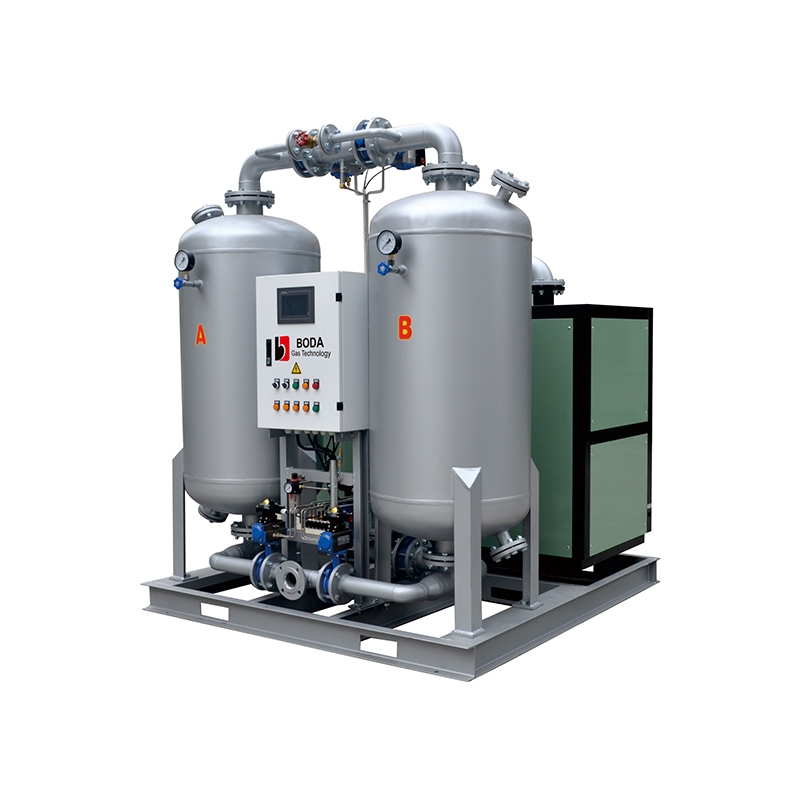
Pressure swing adsorption (PSA) separates oxygen from compressed air using a zeolite molecular sieve that preferentially adsorbs nitrogen at high pressure, allowing oxygen to pass through. A two-vessel setup ensures continuous output while one tower regenerates.
The stages work as follows: air preparation (Air compressor, filters, dryer), adsorption in Tower A where nitrogen is trapped and oxygen exits to a buffer tank, desorption in Tower B where nitrogen is vented to regenerate the sieve, and cycle switching via a programmable logic controller every 50–80 seconds. Key components include the air compressor, multi-stage filtration, twin adsorption towers with zeolite, control valves, and an oxygen buffer tank sized for 10–30 minutes of storage. Typical purity ranges from 93±3% oxygen, adequate for most industrial, aquaculture, and water-treatment applications.
Key Industries Relying on PSA Oxygen Generators
The flexibility of a PSA oxygen generator makes it suitable for a wide range of processes where oxygen purity between 93±3% is sufficient. Flow rates vary from a few Nm³/h for lab use to several hundred Nm³/h for large plants. Major sectors include:
- Aquaculture maintains dissolved oxygen for higher fish stocking density.
- Wastewater treatment: Feeds ozone generation for efficient pollutant breakdown.
- Metallurgy: Boosts flame temperature for cutting and smelting, reducing fuel use.
- Chemical & petrochemical: Improves oxidation reaction yields.
- Food & beverage: Used for modified atmosphere packaging and fermentation acceleration.
- Pharmaceutical: Enhances cell growth in bioreactors.
- Electronics: Supplies oxygen for wafer manufacturing processes.
- Marine: Supports ballast water treatment systems.
- Laboratories: Eliminates cylinder changeover for analytical equipment.
- Energy: Enables oxy-fuel combustion and gasification.
All benefit from on-site generation: no delivery logistics, no handling, and a consistent supply that scales with demand.
PSA vs. VPSA vs. Cryogenic: Choosing the Right Technology
Three on-site oxygen generation technologies dominate: pressure swing adsorption (PSA), vacuum pressure swing adsorption (VPSA), and cryogenic distillation. Each occupies a distinct operational sweet spot.
| Parameter | PSA | VPSA | Cryogenic |
|---|---|---|---|
| Oxygen purity | 90–95% | 90–95% | 99.5%+ |
| Energy consumption | Moderate (0.35–0.50 kWh/Nm³) | 30–40% lower than PSA | High (0.60–1.00 kWh/Nm³) |
| Capital cost | Low to moderate | Moderate to high | Very high |
| Footprint | Compact | Moderate | Large |
| Scalability | 1–200 Nm³/h typical | 100–2,000 Nm³/h | 500–10,000+ Nm³/h |
| Typical application | Aquaculture, wastewater, laser cutting | Steel, chemical oxidation | Large hospitals, steel mills, and petrochemical |
For moderate purity and flows up to 200 Nm³/h, a PSA oxygen generator offers the quickest return with low capital outlay and compact installation. Above 200 Nm³/h, VPSA becomes more efficient due to lower energy consumption, though with higher upfront cost. Cryogenic distillation only makes sense above 500 Nm³/h or when purity must exceed 99.5%. Map your flow and purity against the table to determine the best fit.
Critical Specifications When Selecting a PSA Oxygen Generator
Once PSA fits your flow and purity band, evaluate these technical parameters and supplier qualifications:
- Oxygen purity: Typically 90–95%; medical requires 93%+ or 99.5% with a booster.
- Flow rate: Size for peak demand plus a 10–15% safety margin.
- Power consumption: Lower kWh/Nm³ reduces long-term costs.
- Zeolite quality: LiX or 13X type with 8–10 year lifespan under normal conditions.
- Ambient temperature range: Most systems operate between 5°C and 45°C.
- Footprint: Verify skid dimensions and weight for installation space.
- Maintenance intervals: Account for filter and valve servicing in budget.
Request a technical datasheet for your specific ambient conditions, ask for reference installations in your industry, and verify compliance with ISO 9001 and local regulations. A site audit from the supplier helps avoid costly mismatches.
Frequently Asked Questions and Conclusion
What purity can a PSA oxygen generator achieve?
Standard units deliver 90–95% oxygen. Medical units are tuned to 93%±3% to meet pharmacopoeia standards.
How often does the molecular sieve need replacement?
Zeolite typically lasts 8–10 years when paired with proper compressed air purification. Contaminants accelerate degradation, so annual checks are recommended.
What is the typical payback period?
For facilities consuming over 50 cylinders per month, payback is 12–24 months. A continuous 100 Nm³/h operation can recover capital in about 18 months.
Can PSA generators be used for medical oxygen?
Yes, if the system is certified under ISO 13485 and relevant medical device regulations. Non-medical units cannot supply patient-use oxygen without validation.
Conclusion
Investing in a PSA oxygen generator removes logistical bottlenecks, cuts recurring supply costs, and provides a controllable oxygen supply at 90–95% purity. For any plant with stable demand, on-site generation is the most cost-effective and secure long-term solution. Review your consumption, peak flow, and purity requirements against available units to determine feasibility.
Contact BODA Gas
- BODA GAS TECH
- HANGZHOU BODA PURITY EQUIPMENT CO., LTD.
- You can find us by follows:
- Lemon Du
- Tel./Whatsapp/Wechat: +86-15755150162
- Email: bodagas2002@gmail.com